| The Role of Social Media in Promoting Climate Awareness |
| Author: CH.M. Rasheed Sal |
| Department of Mass Communication, Federal Urdu University, Islamabad |
Abstract
Climate change demands urgent public awareness and collective action. In the digital age, platforms like Facebook, Twitter, Instagram, and YouTube have become key tools for environmental communication. This study examines how social media shapes climate awareness, public opinion, and action.
Unlike traditional media, social platforms enable interactive, real-time engagement, allowing individuals, organizations, and policymakers to reach diverse audiences. Campaigns using hashtags, visual storytelling, and influencer advocacy effectively highlight issues such as global warming, deforestation, and sustainability. Youth-led movements like Fridays for Future demonstrate social media’s power to amplify climate discourse globally.
The study also identifies challenges—misinformation, digital divides, and performative activism—that can limit impact. Using content analysis and surveys, it finds that social media significantly increases environmental awareness, especially among youth, by encouraging dialogue and participation. The findings stress the need for strategic communication, media literacy, and policy support to sustain impact.
- Introduction
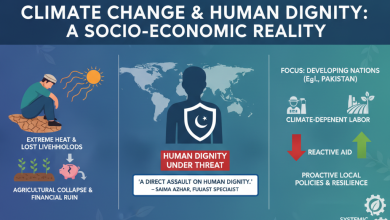
Climate change is one of the most urgent global challenges, marked by rising temperatures, extreme weather, and environmental degradation. Addressing it requires informed public engagement and collective action.
While traditional media has long informed the public, social media has transformed environmental communication. Platforms now enable fast, interactive, and participatory information sharing. They amplify environmental narratives, promote sustainable practices, and mobilize global audiences.
Youth-led initiatives like Fridays for Future show how these platforms can drive awareness and policy advocacy. This study explores how social media shapes climate perception and its potential to influence action.
- Literature Review
Research shows social media enhances public discourse by enabling interactivity and broad participation (Kaplan & Haenlein, 2010). In environmental communication, it has proven effective in raising awareness about climate issues (Boulianne, 2015).
Tools such as hashtags, viral videos, infographics, and influencer campaigns play a central role. Youth movements, in particular, use these tools to shape narratives and pressure policymakers (Heikkilä et al., 2020).
However, misinformation, digital inequality, and performative activism can weaken impact, highlighting the need for media literacy and strategic communication.
- Methodology
This study uses a mixed-methods approach:
- Content Analysis: Examined social media campaigns, hashtags, and influencer posts for messaging strategies and engagement.
- Surveys: Collected responses from 500 individuals (aged 16–35) to assess how climate-related content affects knowledge, attitudes, and behavior.
Data were analyzed to identify links between social media exposure and environmental awareness, attitudes, and participation.
- Findings
- Awareness: Social media exposure significantly improved understanding of climate issues.
- Engagement: Youth showed the highest participation, sharing content and joining movements.
- Influence: Visual content, hashtags, and influencers strongly shaped opinions and encouraged behavioral change.
- Challenges: Misinformation, performative activism, and digital inequality limited effectiveness.
- Discussion
Social media has reshaped environmental communication by enabling real-time, participatory engagement. Campaigns like Fridays for Future illustrate its ability to mobilize global action.
However, impact depends on credibility and strategy. Without media literacy and effective communication, misinformation can undermine progress. Integrating social media efforts with education and policy is essential for lasting results.
- Conclusion
Social media is a powerful driver of climate awareness. It fosters dialogue, engagement, and civic participation, particularly among youth.
Despite challenges, its impact can be strengthened through strategic communication, media literacy, and supportive policies. Leveraging these platforms effectively is key to advancing climate advocacy and achieving meaningful environmental change.
References
Boulianne, S. (2015). Social media use and participation: A meta-analysis. Information, Communication & Society, 18(5), 524–538.
Heikkilä, H., et al. (2020). Youth climate activism on social media. Environmental Communication, 14(7), 923–937.