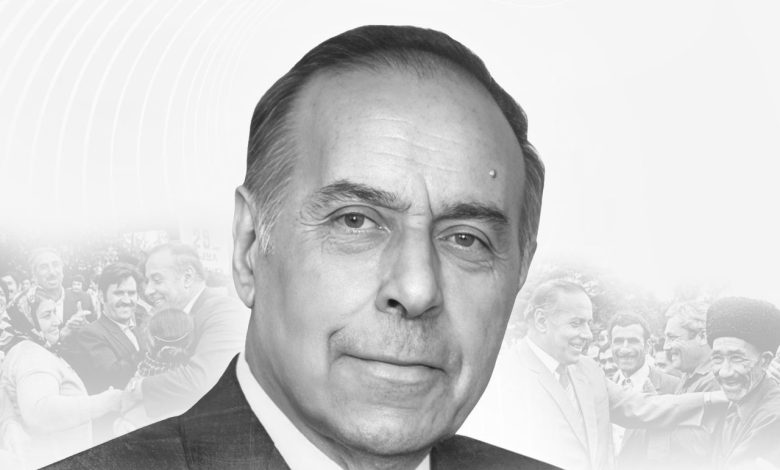
Every year on December 12 the people of Azerbaijan solemnly commemorate the passing of Heydar Aliyev, the National Leader whose life and work shaped the course of the country. His reputation as a strong head of state and a dedicated nation-builder remains central to how modern Azerbaijan is understood.
Under Heydar Aliyev’s leadership the republic transformed from a largely agrarian region in the former Soviet Union into one of its more advanced republics during the 1970s and 1980s, with rapid economic development, hundreds of industrial enterprises, expanded employment opportunities, and growth in secondary and higher education that supported broad social progress.
The return of Heydar Aliyev to leadership in June 1993 is widely credited with steering the country away from the brink of political and economic collapse. He articulated a clear economic direction, stating, “By applying the principles of a market economy, creating a free economy, and considering it as the main path, all of this should be directed towards improving the welfare and social status of all layers of the population,” and set in motion measures to rebuild the national economy and protect social welfare.
Major strategic initiatives launched under his leadership, including the Contract of the Century and the Baku–Tbilisi–Ceyhan pipeline, laid the foundations for Azerbaijan’s international role and long-term development. Those projects, conceived during the era of Heydar Aliyev, have continued under President Ilham Aliyev, and recent achievements such as victory in the 44-day Patriotic War and the liberation of occupied territories are seen as fulfilling long-held national aspirations.
The 1995 Constitution authored under the National Leader enshrines state obligations to social protection and a decent standard of living, reflecting his focus on citizens’ welfare. The name and legacy of Heydar Aliyev remain deeply embedded in national memory, and his life is regarded as an essential chapter in the history of Azerbaijan that future generations will continue to study and uphold.