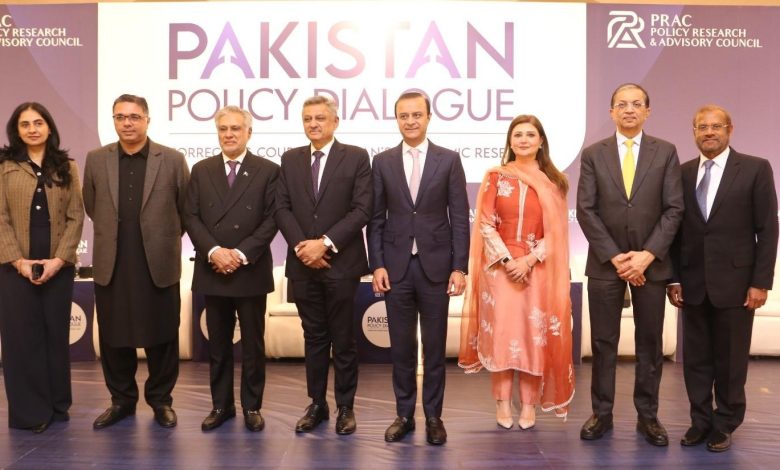
Senator Muhammad Ishaq Dar, Deputy Prime Minister and Foreign Minister, called for sustained policy continuity and technology-enabled governance to advance Pakistan’s economic reset at the Pakistan Policy Dialogue in Islamabad. He said resetting the economy requires responsible governance, consistent policies and institutions that endure beyond political cycles so policy intent yields measurable outcomes.
Dar highlighted the government’s diplomatic efforts aimed at expanding export opportunities and building mutually beneficial commercial partnerships. He stressed that a clear, stable policy framework and digital public service delivery are essential to translating reforms into investor confidence and export growth.
The Dialogue convened senior policymakers, business leaders and development experts to map pragmatic reform pathways focused on the economic reset, digitization, institutional strengthening and growth-oriented policy choices. The event was organised by the Policy Research and Advisory Council in collaboration with the Corporate Pakistan Group and Nutshell Group, with the Ministry of Commerce and the Trade Development Authority of Pakistan as founding partners and support from Bank Alfalah and BankIslami.
Speakers including Prof. Ahsan Iqbal, Senator Muhammad Aurangzeb, Senator Dr. Musadik Malik and Dr. Ishrat Husain emphasised the balance between short-term stabilisation and long-term development. Prof. Iqbal noted the need for improved planning, productivity and export competitiveness, while Senator Aurangzeb underlined macroeconomic stability and the formalisation of emerging sectors such as crypto and blockchain to harness youth-led growth.
Panelists pointed to structural reforms as central to the economic reset. Muhammad Ali urged focus on privatisation and leaving areas suited to private enterprise, and Dr. Husain recommended shifting emphasis toward services exports and human capital as technology changes global trade dynamics. Muhammad Younus Dagha highlighted recent macroeconomic improvements, citing lower inflation, rising reserves and a current account surplus, and warned that preparedness for future disruptions such as AI must be part of the reset strategy.
Sessions on bridging the digital divide and green growth explored practical measures to strengthen digital infrastructure, financial inclusion and climate financing. Industry leaders called for accelerated government digitisation, wider adoption of digital payments and innovative financing instruments including green bonds, sukuk and tokenisation to mobilise private capital for decarbonisation and resilience.
Speakers from the private sector, including Mohammad Ali Tabba, stressed that translating dialogue into delivery requires tackling structural bottlenecks in energy, water and exports while pursuing privatisation and investment in human capital. There was consensus that a durable economic reset hinges on predictable policy, stronger institutions and sustained public–private collaboration to create jobs and restore competitiveness.
The Pakistan Policy Dialogue concluded with a shared commitment to deepen evidence-based policymaking and follow through on reform priorities that underpin the economic reset, with future editions planned to maintain momentum between policymakers, business leaders and development partners.