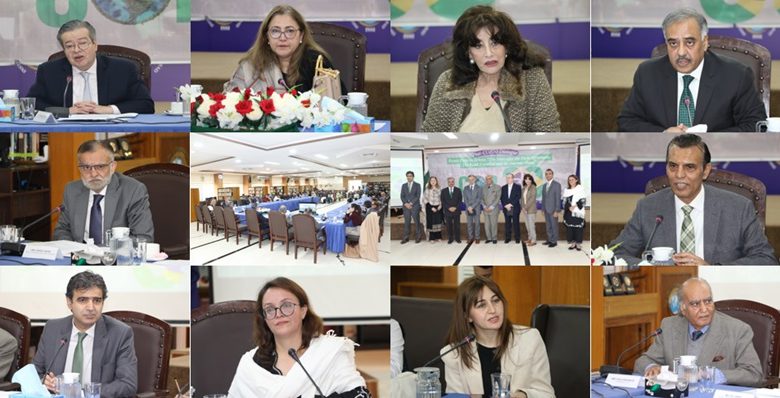
The Institute of Strategic Studies Islamabad and the Civil Society Coalition for Climate Change, supported by the Embassy of France in Pakistan, convened a post-COP30 dialogue to assess ten years since the Paris Agreement and chart the path forward for Pakistan. Senior government officials, diplomats, development partners and civil society examined COP30 outcomes and focused on the practical steps needed to unlock climate finance and strengthen national resilience.
Dr. Neelum Nigar opened the session by underscoring that COP30’s conclusions demand sustained commitment, cooperation and informed action, especially for vulnerable countries like Pakistan. Director General ISSI Ambassador Sohail Mahmood warned that Belem exposed widening gaps between ambition and delivery, notably on finance, just transition and the operationalisation of the Loss and Damage Fund. He reiterated Pakistan’s vulnerability despite contributing less than one percent of global emissions and urged accessible, predictable and grant-based climate finance backed by long-term international partnerships.
Aisha Khan of the Civil Society Coalition for Climate Change called for climate discourse to be anchored in evidence, equity and national preparedness. She argued Pakistan must move from reactive crisis response to proactive planning based on resilience, data and stronger regional collaboration, and welcomed the shift to a post-COP reflection format to inform the country’s posture for COP31.
In her keynote address, Secretary MoCC Aisha Humera Moriani positioned COP30 as an implementation COP and outlined Pakistan’s submission of NDC 3.0, a more ambitious national roadmap through 2035. She stressed that shortfalls lie less in pledges than in the means of implementation — finance, technology and capacity building — and warned that climate impacts from glacial melt to repeated floods threaten food security, water systems and public health. Ms. Moriani insisted adaptation finance must be grant-based to avoid adding debt burdens, welcomed the Loss and Damage Fund’s operationalisation and called for its significant capitalisation, direct access modalities and simplified procedures, alongside joint research and sub‑national leadership.
Ambassador Nicolas Galey of France reflected on the difficult global climate picture while reaffirming France’s commitment to ecological transition and climate justice. He highlighted France’s legal target of carbon neutrality by 2050, a 19 percent emissions reduction since 2017 and sustained annual climate financing in excess of €6 billion for developing countries, noting ongoing gender-focused and academic partnerships in Pakistan.
Ambassador Nabeel Munir reviewed COP30 outcomes, describing Belem as emblematic of widening global divides and welcoming the decision to triple adaptation finance by 2035 while cautioning that timelines, baselines and definitions remain unclear. Pointing to Pakistan’s NDC 3.0, which includes a 50 percent emissions reduction pathway by 2035, he stressed that national ambition requires accessible finance and affordable technology and reiterated the long-standing call that adaptation support be grant-based.
Dr. Abid Suleri located COP30 within the arc from Kyoto to Paris to Belem and called for bottom-up governance that channels district-level inputs into provincial and national planning, plus a regional coalition of the willing in South Asia. From a financing perspective, Mr. Hiz Jamali of the Asian Development Bank noted implementation bottlenecks such as slow disbursements and project delivery gaps, and urged bankable project design, blended finance strategies, strong execution capacity and transparent monitoring to unlock larger flows of climate finance for Pakistan.
The dialogue closed with an interactive exchange on strengthening domestic capacity, deepening institutional collaboration and sustaining climate diplomacy to translate COP30 outcomes into local action. Ambassador Khalid Mahmood, Chairman Board of Governors ISSI, offered a vote of thanks and presented mementos to the event’s distinguished speakers and participants, reaffirming the drive to mobilise climate finance and resilience measures for Pakistan.