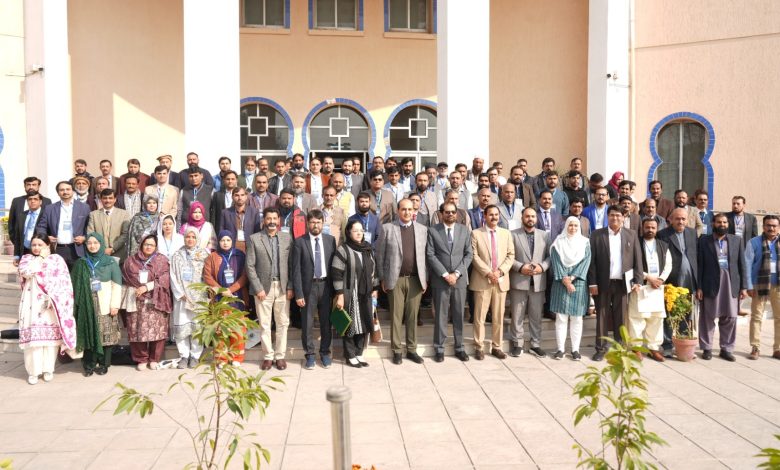
The Inter Boards Coordination Committee (IBCC) convened a two-day workshop at the WM Zaki Auditorium of Allama Iqbal Open University to strengthen capacities of master trainers and item writers and promote EdTech training across Pakistan. Experts, teachers and educational leaders from around the country attended sessions designed to support digital transformation and raise teaching and assessment standards in classrooms.
Dr Ghulam Ali Mulla, Executive Director of IBCC, highlighted the urgent need for technology-driven teaching environments and stressed that meaningful reform depends on teachers who can integrate tools thoughtfully. He said, “We must move beyond formal use of technology and equip teachers to apply it with confidence and pedagogical intent.” The focus on EdTech training was positioned as central to that mission.
Dr Chaudhary Faisal Mushtaq (TI), CEO of Roots Millennium Schools, underscored the teacher’s role in successful digital reforms, noting that institutions can introduce technology but lasting change requires teachers to adopt technical and AI-related skills into daily practice. He praised IBCC’s initiative for fostering cooperative national efforts in education.
Honorary guest Dr Samia Rehman Dogar, Director at Federal College of Education (MOFE&PT), commended IBCC’s nationwide vision and described the integration of technology into examination boards as a forward-looking strategy for Pakistan’s education system. Practical sessions included a lecture on the moral foundations of education by Professor Dr Abdul Saboor, former Dean of Social Sciences at Arid University, emphasizing ethics and character formation alongside technical skills.
Dr Naeem Khalid, Senior Editor at CANTAB Publishers, led a session on the use of ed-tech in classroom assessment that explored reliable assessment practices through technology. Participants worked in thematic groups on curriculum comprehension, Bloom’s taxonomy and the development of high-quality MCQs under guidance from senior experts representing A K U E B, PIE, ICM and ESED. These activities reinforced the hands-on, practice-oriented approach to EdTech training promoted throughout the workshop.
The two-day programme aimed to translate policy and tools into classroom impact by building a network of trained master trainers and item writers capable of sustaining improved assessment and instruction practices. IBCC said the initiative will continue to support follow-up training and resource sharing to ensure the gains from this EdTech training reach schools and students nationwide.