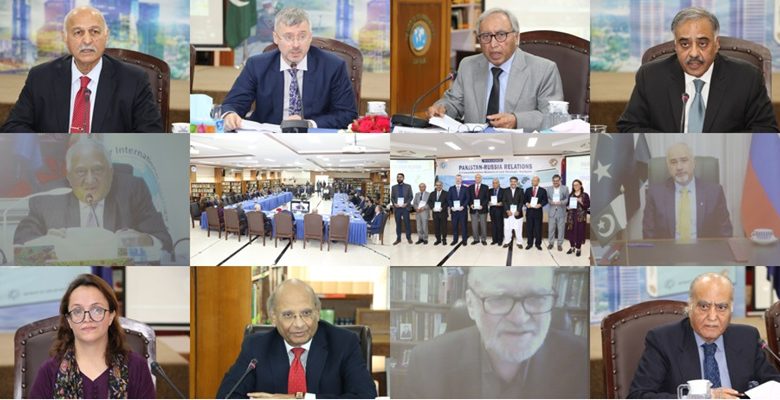
The Institute of Strategic Studies Islamabad, through its Centre for Strategic Perspectives, launched a new edited volume that maps the evolution and future trajectory of Pakistan Russia ties. The book brings together scholars and practitioners to trace seven decades of interaction, from Cold War tensions to a growing, pragmatic partnership across diplomacy, defence and economic cooperation.
Director General ISSI Ambassador Sohail Mahmood opened the event by underlining the long arc of Pakistan Russia relations and the recent phase of recalibration. He noted that despite early geopolitical constraints the relationship never fully broke down, pointing to Soviet-era support for Pakistan’s industrial projects and mediation efforts such as the Tashkent Declaration. Ambassador Mahmood said high-level exchanges, strengthened defence dialogue and expanding cooperation in counterterrorism, energy and agriculture now mark a new chapter.
Senator Mushahid Hussain Syed, as chief guest, offered a historical lens on the bilateral relationship and highlighted early instances of Soviet goodwill toward Pakistan. He argued that the present international realignment and the rise of the Global South create opportunities for deeper engagement and recommended education, culture, energy and connectivity as anchors for the next phase. Senator Mushahid also endorsed the idea of a Eurasian Connectivity Forum in Pakistan to broaden regional linkages.
Russian Ambassador Albert P. Khorev, speaking as guest of honour, described the book as a landmark contribution and outlined tangible signs of progress, including rising trade, ongoing talks on major projects like the reconstruction of Pakistan Steel Mills and an increase in Russian scholarships for Pakistani students. He emphasised Russia’s interest in Pakistan as a regional actor central to connectivity initiatives under the Greater Eurasian Partnership concept.
Discussants underlined both promise and obstacles. Dr. Rasul Bakhsh Rais highlighted emerging convergence on counterterrorism, stability in Afghanistan, energy security and trilateral cooperation, while cautioning that sanctions, banking restrictions, historical mistrust and Afghan instability remain significant impediments. Dr. Vyacheslav Belokrenitsky observed growing Russian academic interest in Pakistan and called for sustained scholarly collaboration to deepen mutual understanding.
Ambassador Qazi M. Khalilullah drew on decades of diplomatic experience in Moscow to note that contemporary ties rest on mutual respect and expanding cooperation in defence, energy and multilateral forums such as the SCO. A video message from Ambassador Faisal Niaz Tirmizi confirmed that bilateral trade had reached USD 1 billion before banking and sanctions-related disruptions and urged greater facilitation for students, scholars and cultural exchanges to strengthen people-to-people links.
Contributors from both countries briefly outlined their chapters, reflecting a range of perspectives that collectively aim to inform policymakers and practitioners. The discussion pointed to practical priorities for advancing Pakistan Russia cooperation: institutionalised engagement, renewed cultural diplomacy, improved financial channels and clearer frameworks for major economic projects such as the Pakistan Stream Gas Pipeline.
Ambassador Khalid Mahmood offered the vote of thanks, noting that while Cold War constraints once limited ties, Pakistan Russia relations are now on a path of steady improvement. The book’s release is presented as a timely intervention to support that momentum by offering fact-based analysis and policy-oriented recommendations for deeper diplomatic, economic and academic engagement.