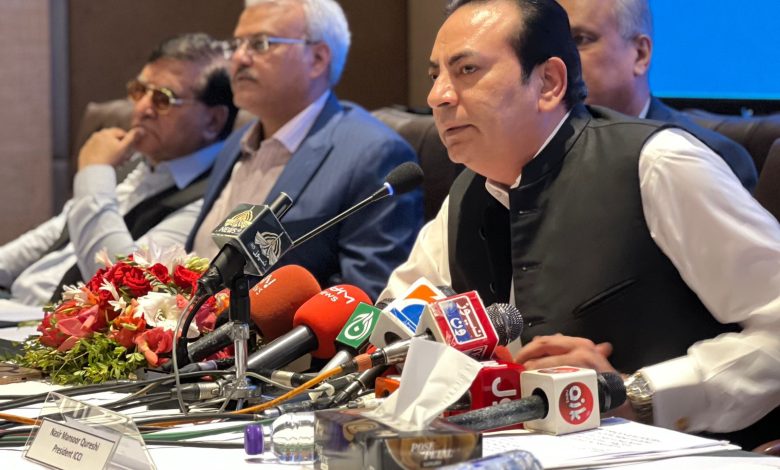
Pakistan’s business community leaders, including officials from key chambers of commerce and industry, have expressed deep concern over the country’s challenging economic situation and pushed for major structural reforms. In a high-profile press conference, they outlined urgent measures needed to stabilize the economy, foster sustainable growth, and enhance prosperity across all segments of society.
Nasir Mansoor Qureshi, President of the Islamabad Chamber of Commerce and Industry, emphasized that Pakistan stands at a critical crossroads with significant economic challenges to overcome. He stressed that only through sustainable economic reforms and effective resolution of key issues can Pakistan set itself back on a path to growth. Qureshi underscored the pivotal role of the business community as stakeholders, declaring their readiness to actively participate in the country’s economic revival.
Atif Ikram Sheikh, President of the Federation of Pakistan Chambers of Commerce and Industry, strongly advocated for administrative restructuring, including the creation of new provinces, to ensure the benefits of economic reforms reach the grassroots level. He called for enhanced district-level economic development, arguing it was essential for Pakistan’s long-term prosperity.
Sheikh reaffirmed that the business community stands firmly alongside the government to restore the economy. Among the key steps he highlighted were bringing interest rates down to single digits, reducing electricity prices, and accelerating infrastructure development. He stressed that completing privatization processes without delay was critical for economic competitiveness.
Looking ahead, the FPCCI President announced the federation’s ambitious target to raise national exports to 100 billion dollars by the year 2030. He stressed the need to strengthen the local economy as a foundation for higher export output and noted that Pakistan’s existing administrative structure was insufficient for managing such a large population efficiently.
S M Tanveer, Patron-in-Chief of the United Business Group, also spoke at the conference, highlighting the potential for significant export growth, stating that every sector could contribute up to 5 billion dollars annually. He praised the efforts being made to develop a robust industrial policy and lauded Pakistan’s armed forces for their courage in defending the nation. Tanveer maintained that after military victories, the next great battle is economic, and expressed confidence that Pakistan would succeed.
However, Tanveer pointed to areas of concern, including the decline of the agricultural sector and the lack of value addition across industries. He cited the fall in cotton production from fifteen to five million bales as an example of this downturn. Comparing Pakistan’s economy to neighboring India, Tanveer noted that Pakistan’s economic size lags far behind.
He further proposed that a one percent reduction in interest rates could lower government borrowing costs by 3,500 billion rupees. He flagged Pakistan’s 40 billion dollar trade deficit and the annual loss of 12 billion dollars in interest payments, while the country continues to seek financial support from the International Monetary Fund for much smaller amounts.
Collectively, the speakers called for coherent policy decisions, visionary reforms, and strong public-private collaboration to overcome economic hurdles and lead Pakistan toward a more prosperous future.